
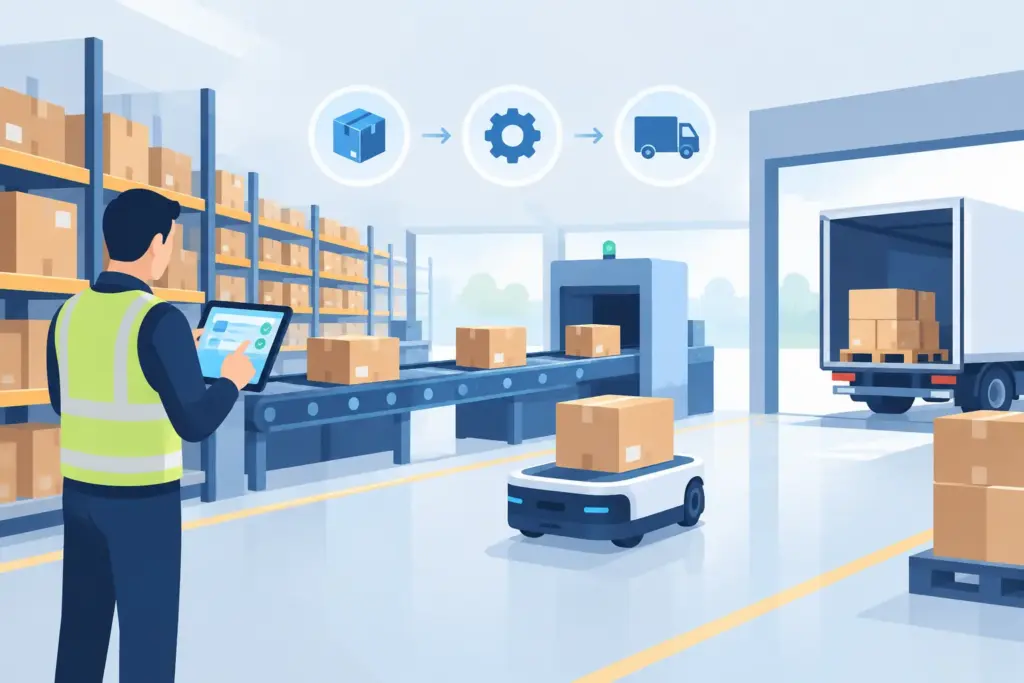
A packed despatch bench, a missed collection cut-off and a customer asking where their order is: this is where manual processes become expensive. When teams have to switch between carrier portals, rekey order details and make shipping decisions order by order, despatch speed and service consistency are left to chance.
To automate warehouse dispatch workflows is to replace those repeated decisions and hand-offs with rules, connected data and a single operational view. Done well, automation does not remove control from the warehouse team. It gives them more of it – freeing people to manage exceptions, maintain service standards and keep orders moving when volume rises.
Why warehouse despatch still creates friction
Most warehouse teams do not start with a broken process. They start with a workable one: print orders, select a carrier, create a label, manifest the parcel and hand it to the driver. The challenge appears as the business grows, adds sales channels, introduces international delivery or gives customers more delivery options.
Each additional carrier can bring another portal, label format, collection process and set of service rules. A customer promise made at checkout may not be visible to the packing team. Stock, address and customs data can sit in separate systems. By the time an issue is spotted, the parcel may have missed the day’s final collection.
The result is familiar: labels are created manually, carrier selection relies on individual knowledge, and reporting arrives too late to improve the shift that is already under pressure. Automation addresses these weak points by making the right information available at the moment it is needed.
What it means to automate warehouse dispatch workflows
Dispatch automation connects the systems that hold order, customer, inventory and carrier information, then applies rules to the journey from order release to collection. Instead of asking an operative to decide how every parcel should travel, the workflow can use pre-agreed logic to create the right label, documentation and carrier instruction.
That logic may account for destination, parcel weight, dimensions, order value, delivery promise, prohibited items, carrier capacity or the customer’s preferred service. For cross-border shipments, it can also use the data required for customs documentation before the parcel reaches the packing bench.
The objective is not to send every order by the cheapest service. It is to choose the most appropriate service against the commercial and customer requirements of that order. A low-value domestic parcel, an urgent replacement and a high-value export should not necessarily follow the same rule.
The workflow behind a better despatch operation
A connected workflow usually begins when an approved order is released from an eCommerce platform, ERP or warehouse management system. Order information is validated, including the address, contact details, product data and any delivery instructions. If key information is missing, the order is held for review rather than becoming a problem on the carrier portal.
The system then applies shipping rules and selects an eligible service. It generates a label and, where needed, customs paperwork. The warehouse receives a clear instruction to pack and despatch. Tracking information flows back to the order management system and customer communications, while manifesting and collection information are prepared for the carrier.
The value lies in the continuity of that process. Teams should not need to copy data between screens or reconcile separate carrier reports at the end of the day.
Start with the decisions that slow the team down
Before introducing technology, map the points where people repeatedly stop to make a decision or correct information. These are often better candidates for automation than the physical act of packing a parcel.
Look closely at carrier selection, label creation, address checking, service upgrades, customs declarations, manifesting and tracking updates. A process may only take an extra minute per order, but at 2,000 parcels a day that minute becomes a material operational cost – and a source of avoidable errors.
It is also worth distinguishing between rules and exceptions. Rules are predictable decisions that can be applied consistently. Exceptions need human judgement, such as a destination affected by disruption, a customer complaint requiring priority treatment or an oversized item that falls outside standard carrier criteria. Good automation routes exceptions clearly rather than trying to force every order through the same path.
Build carrier rules around the customer promise
Carrier choice is where automation can create a significant commercial advantage. A multi-carrier strategy gives businesses alternatives when a service is unavailable, costs change or a destination needs a specialist solution. But choice only improves performance when it is governed by rules that reflect what the business has promised customers.
For example, a retailer might define rules for standard UK delivery, next-day orders placed before a cut-off, remote postcodes, high-value consignments and international services. A wholesaler may prioritise timed delivery, proof of delivery or consignee-specific requirements. The right rule set depends on the product, customer base, margin and service proposition.
Avoid building rules solely around headline price. The lowest-cost carrier may be the right choice for a non-urgent parcel, but less suitable for a premium order where delivery reliability protects revenue and customer loyalty. Assess cost alongside delivery performance, claims exposure, capacity, collection timings and the experience the recipient receives.
Connect data once, then use it across the operation
Automation is only as reliable as the data behind it. Inaccurate weights, incomplete addresses and vague product descriptions create delays regardless of how advanced the label-generation process may be. The practical goal is to capture quality data at source and prevent it being retyped elsewhere.
For international despatch, that means maintaining accurate product descriptions, values, country of origin and commodity codes where applicable. These details should be part of the order and product workflow, not collected hurriedly after an order has reached the warehouse. This reduces the risk of customs delays and gives operations teams confidence that the documentation matches the goods.
Integration matters here. A platform should exchange data with the systems your team already uses, whether that is an eCommerce platform, ERP, WMS or marketplace. Team AGL’s Clearview platform is designed to bring carrier connectivity and despatch activity into one place, helping businesses replace fragmented shipping tasks with a clearer operational workflow.
Test the exceptions before scaling the volume
A dispatch workflow can look perfect when tested against standard UK parcels. The real test is how it handles the awkward orders: a partially fulfilled order, an address that fails validation, a parcel over a carrier’s size threshold, a Saturday service, a restricted item or an international order with missing customs data.
Run controlled tests using real order scenarios before moving all volume across. Confirm which orders should route automatically, which should be held, and who owns the resolution of each exception. Warehouse teams need clear on-screen prompts and a fast route to support, not a new system that leaves them guessing.
Peak planning should be part of the test. If volumes double during a promotion or seasonal period, can the rules still assign services correctly? Are label printers, packing stations and collections sized for the new throughput? Automation removes administrative bottlenecks, but it cannot compensate for insufficient physical capacity or unrealistic carrier collection arrangements.
Measure the outcomes that matter
The first measure is often labels produced per hour, but dispatch automation should be judged more broadly. Track despatch accuracy, the percentage of orders released without manual intervention, missed collection cut-offs, carrier allocation by service, delivery performance and customer contact rates relating to tracking.
These measures reveal whether automation is improving the whole delivery experience rather than simply speeding up label production. If customer queries fall because tracking is more accurate, or if the warehouse can despatch later without increasing labour, that is a meaningful gain. Equally, if a routing rule sends too many parcels through an underperforming service, the data gives you a reason to adjust it.
Treat rules as operational decisions that need regular review. Carrier networks change, service levels fluctuate, product ranges evolve and customers develop new expectations. The most effective workflows are not set once and forgotten. They are refined using performance data and feedback from the people packing parcels every day.
Give warehouse teams control, not more screens
The best automation feels straightforward at the packing bench. Operatives should be able to scan, pack, print and move to the next order with confidence that the carrier, service and paperwork have already been checked. Supervisors should have visibility of held orders, collection status and performance without chasing updates across multiple systems.
That is how dispatch becomes a source of competitive advantage rather than a daily administrative burden. Start with the points where manual work creates the most delay, build rules around the delivery promise, and keep improving them as your operation grows. Every parcel is a customer interaction – your workflow should make it one worth repeating.