
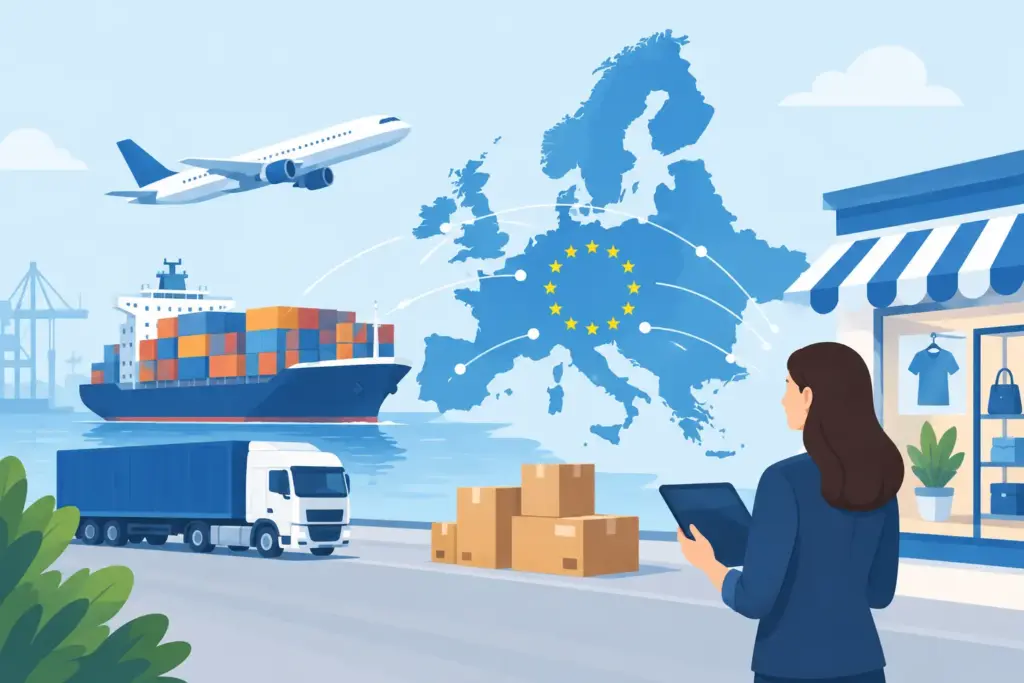
A customer in Paris, Berlin or Madrid should not discover an unexpected customs bill after they have paid at checkout. That single moment can turn a well-earned international sale into a refused delivery, a costly return and a customer who will not order again. DDP shipping to Europe gives retailers more control over that experience by putting duties, taxes and clearance arrangements into the shipping plan before the parcel leaves the UK.
For growing brands, this is not simply a question of choosing an Incoterm. It is a commercial decision about margin, delivery promise, data quality and who owns the customer relationship when a parcel reaches the border.
What DDP means for European parcel delivery
DDP stands for Delivered Duty Paid. Under this Incoterm, the seller takes responsibility for getting goods to the agreed destination, including export formalities, import clearance, duties and applicable taxes. The buyer receives the parcel without being asked to pay charges on arrival, provided the shipment has been correctly declared and the agreed DDP model is in place.
That is a powerful proposition for eCommerce. A shopper sees a clearer final price, the delivery journey feels more predictable and the brand remains in control of a critical part of the post-purchase experience. It can be especially valuable in markets where consumers expect duties and taxes to be dealt with upfront rather than collected at the door.
DDP does not mean every cross-border complication disappears. The seller still needs the right commodity data, correct customs valuation, a workable import tax arrangement and a carrier service that supports the destination and product category. Responsibility increases, so the operational model has to be strong enough to support it.
When DDP shipping to Europe makes commercial sense
DDP is often the right fit when customer experience is a priority and the retailer can model landed costs with confidence. Fashion, beauty, accessories, consumer electronics and subscription businesses can all benefit, particularly where parcel values and repeat purchase rates make surprise fees damaging to conversion and loyalty.
It can also create a more consistent proposition across European markets. Instead of asking every customer to understand local import processes, brands can present delivery as a managed service. That is easier to communicate in checkout, promotional campaigns and customer service conversations.
The trade-off is financial exposure. Duties and import VAT can vary by product, origin, value and destination. Absorbing those costs without accurate data can erode margin quickly. For some low-margin products, remote areas or less predictable lanes, DDP may not be the best choice. A business may decide to offer it only on selected routes, above a basket threshold or for product ranges where duty costs are known and manageable.
DDP also requires clarity on the importer of record. The party legally importing goods into the destination country may need local registrations, a fiscal representative or a specialist customs arrangement depending on the market and goods involved. An operationally convenient solution is not automatically a compliant one, so this should be reviewed with customs and tax specialists before launch.
Build a DDP model around your real trading lanes
A reliable service begins with the products and countries you actually ship, not a generic European rulebook. France, Germany, Italy and Spain may be priority markets, but each lane can have different carrier strengths, delivery expectations and compliance requirements.
Start with product and customs data
Every SKU needs a clear commercial description, correct commodity code, country of origin, value and weight. Vague descriptions such as clothing, gift or parts create avoidable customs queries. The information should explain what the item is, what it is made from and, where relevant, its intended use.
Commodity codes and origin deserve particular attention. Two similar-looking products can attract different duty treatment, while preferential origin rules may reduce duty on qualifying goods. However, goods shipped from the UK do not automatically qualify as UK origin. Retailers should avoid making assumptions based on dispatch location alone.
Create a process that keeps this data current as ranges change. Customs accuracy is not a one-off implementation task. New suppliers, bundle offers, promotional samples and seasonal products can all introduce fresh compliance risks.
Choose the right VAT and import approach
For many business-to-consumer shipments valued at €150 or below, the EU Import One-Stop Shop, known as IOSS, may offer a practical way to collect VAT at checkout and declare it through a single return. It can support a cleaner customer experience, but it does not cover every scenario and does not remove the need for good shipment data.
Higher-value consignments, excise goods, restricted products and business-to-business movements need separate consideration. The correct approach may involve local VAT registrations, deferred accounting, a nominated importer or another customs structure. The point is to match the tax design to the flow of goods rather than forcing every order through one process.
Match the carrier service to the promise
Not all European parcel services offer the same DDP capability, transit profile or customs model. A service that performs well for low-value fashion parcels to France may not suit higher-value electronics to Norway or multi-parcel orders to Italy.
Assess carriers on more than headline transit time. Look at pre-clearance capability, data requirements, tracking events, delivery options, surcharge structures, claims handling and the way duties and taxes are funded and reconciled. The most competitive label price can become expensive if it produces customs holds or failed deliveries.
A multi-carrier strategy gives businesses room to select services by lane, parcel profile and customer promise rather than relying on a single network for every scenario.
Make landed cost visible before checkout
The purpose of DDP is undermined if the customer cannot understand what they are paying. Where possible, display a clear landed price that accounts for the applicable duty, tax and delivery charge. If costs depend on the final destination or order composition, calculate them dynamically and make exclusions clear.
This also protects your customer service team. When the price shown at checkout matches the experience at the door, fewer customers contact support to challenge charges or ask why a parcel is delayed. Finance teams benefit too, because duty and tax costs can be compared against the values used in pricing and margin decisions.
There is a balance to strike. A fully absorbed-duty offer can be a compelling acquisition tool, but it should be tested against actual outcomes by country and category. Some brands build duty into product pricing, while others separate it as a transparent landed-cost line. The right choice depends on brand positioning, competitor behaviour and price sensitivity in each market.
Treat customs data as part of customer experience
A parcel can be physically ready for collection and still fail to move because its electronic data is incomplete. For DDP shipping, customs information is as fundamental as the delivery address.
Your order management, warehouse and carrier systems need to pass consistent data at the right point in the fulfilment workflow. That includes recipient contact details, product descriptions, values, commodity codes, origin and any required tax references. Manual rekeying creates delays and makes auditing harder, particularly at peak.
This is where connected technology changes the practical workload. A platform such as Clearview can bring carrier services and parcel workflows into one environment, helping teams apply the right service rules, generate labels and maintain clearer operational visibility without switching between separate carrier portals. The value is not just speed at dispatch. It is the ability to standardise decisions while retaining flexibility as routes, carriers and volumes change.
Measure the service after launch
A DDP programme should be monitored like any customer-facing delivery product. Track customs hold rates, clearance times, first-attempt delivery, refused parcels, duty and tax variance, delivery exceptions and the cost of returns. Segment the results by country, carrier, product category and order value.
These measures reveal where the issue really sits. A high exception rate might point to poor address capture, an unsuitable carrier handover, missing customs data or a pricing rule that does not reflect the actual duty treatment. Without this detail, teams can mistake a process problem for a carrier problem, or vice versa.
It is also worth reviewing the customer-facing message. Delivery pages, checkout copy and tracking communications should accurately explain that duties and taxes are handled, while avoiding promises that go beyond the service conditions. Clear wording creates confidence without setting an expectation the operation cannot consistently meet.
The strongest European delivery proposition is rarely built by treating customs as a back-office afterthought. It comes from making data, carrier choice, tax planning and customer communication work as one service. Get that operating model right, and DDP becomes more than a shipping term – it becomes a reason for customers to buy with confidence again.