
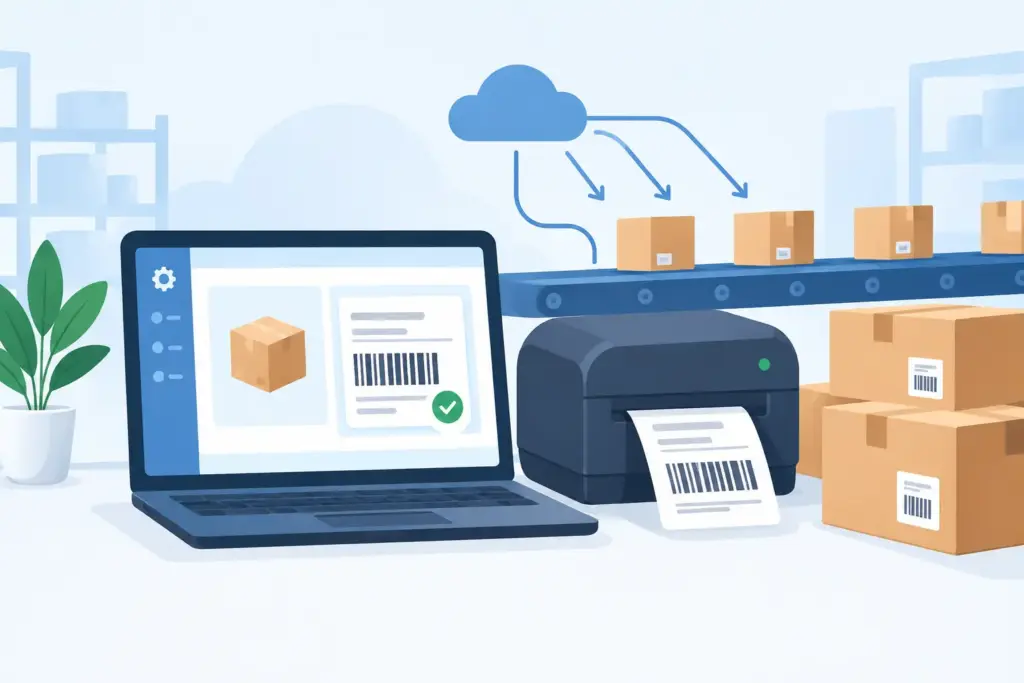
A busy despatch bench should not become a decision-making bottleneck. Yet for many growing retailers, every order still creates a chain of manual tasks: choosing a carrier, copying address details, checking a service, producing paperwork and fixing avoidable errors. Automated shipping label generation replaces that friction with a controlled, repeatable workflow that keeps parcels moving and customers informed.
For high-volume businesses, this is not simply about printing labels faster. It is about connecting fulfilment decisions to live order data, carrier services and delivery promises. Done properly, automation gives operations teams more control as parcel volumes, destinations and customer expectations increase.
Why automated shipping label generation matters
A shipping label is a small piece of paper with a significant operational role. It tells the carrier where the parcel is going, which service should carry it, how it should be handled and how its journey can be tracked. If the data is incomplete, formatted incorrectly or assigned to the wrong service, the cost is rarely limited to one label. It can mean delayed collections, failed delivery attempts, customer contacts, manual rework and avoidable claims.
Manual processes may appear manageable when order volumes are low or predictable. The pressure changes during a promotion, seasonal peak or expansion into new markets. Teams start switching between carrier portals, maintaining spreadsheet rules and relying on individual knowledge to keep the operation moving. That approach makes it harder to protect service quality when it matters most.
Automated label generation moves the decision closer to the order itself. Once an order is ready to despatch, the system can apply predefined rules, select an appropriate service, validate the information and create the carrier-compliant label. The result is a faster handover from checkout or warehouse management system to carrier network, with fewer opportunities for human error.
The commercial value is just as important. Better automation helps businesses use the right service for the parcel, destination and promised delivery date, rather than defaulting to the route that happens to be easiest to process. That creates room to manage cost without treating delivery experience as an afterthought.
What a high-performing workflow should do
The strongest workflows do more than turn order data into a printable PDF. They connect the practical realities of fulfilment to a business’s customer proposition.
At the point of despatch, the platform should receive accurate order data from the eCommerce platform, ERP or warehouse system. This includes recipient details, parcel weight and dimensions, item value, delivery preference and, where relevant, customs information. Address validation can flag problems before a parcel enters the network, while service rules can account for postcode, destination country, cut-off time, product type and promised delivery speed.
Carrier selection is where multi-carrier technology earns its place. A next-day service may be right for an urgent UK order, while an economy option may better suit a non-urgent delivery. A business sending to remote areas, Europe or markets further afield may need different rules again. Automation should support that choice, not force every parcel through a single carrier or a one-size-fits-all service.
The label is then generated in the required carrier format, including the barcode and tracking reference. At the same time, the workflow can create manifests, customs documents and notifications where they are needed. Warehouse teams get a clear instruction they can act on, while customers receive useful visibility after despatch.
This does not mean every decision should be fully automatic. Exception management is essential. A well-designed set-up gives teams a clear route to review orders with missing data, unusual dimensions, restricted goods or address queries. Automation deals with the routine volume quickly, so skilled people can focus on the shipments that genuinely require judgement.
The data foundation cannot be ignored
Automation only performs as well as the information behind it. A label engine cannot compensate for an incorrect delivery address, outdated product weight or incomplete commercial invoice. Before introducing automated processes, businesses should examine where order data originates and who owns its quality.
For international shipping, that scrutiny becomes more important. Commodity descriptions, country of origin, item values, tax references and Harmonised System codes can affect customs clearance. The right workflow can prompt for required information and apply country-specific logic, but teams still need reliable product data and clear accountability.
This is one of the key trade-offs. More automation can reduce routine handling, but overly complicated rules built on poor data create confusion at speed. Start with the decisions that are repeated most often and have a measurable effect on cost, delivery performance or labour time. Add complexity only where it delivers a clear operational gain.
Building rules around the customer promise
The question is not merely, “Which carrier is cheapest?” It is, “Which delivery option best fulfils the promise we made to this customer?” That distinction matters for brands competing on convenience, reliability and post-purchase experience.
A sensible rules strategy may prioritise next-day delivery for orders placed before a stated cut-off, select a tracked service for higher-value goods, or route international parcels through a carrier with appropriate destination coverage. It can also account for collection schedules and warehouse capacity. The best rule is not always the lowest-cost option in isolation; it is the option that balances spend, performance and customer expectation.
Customer choice also has a role. If shoppers have selected a premium delivery service, click and collect, a safe-place preference or a nominated day, that preference should follow the order into fulfilment. Disconnected systems are where these commitments can be lost. An integrated approach keeps the checkout promise and the carrier instruction aligned.
For businesses operating across several sales channels, consistency matters. A marketplace order, wholesale replenishment and direct-to-consumer parcel may require different services and documents, but they should not require separate, disconnected despatch processes. Centralising carrier access makes it easier to apply common standards while preserving the flexibility each channel needs.
Integration changes the day-to-day operation
The most valuable label automation is integrated into the systems people already use. Asking warehouse colleagues to rekey order information into a carrier portal is slow, difficult to audit and vulnerable to mistakes. A direct connection between order management, warehouse operations and a multi-carrier platform reduces duplicated work and provides a clearer record of what happened to each consignment.
Integration also creates better visibility for operations leaders. They can see despatch volumes by carrier and service, identify where exceptions are occurring and assess whether rules are delivering the intended result. If a carrier changes a service area, a customer promise changes or peak demand alters capacity, the workflow can be adjusted centrally rather than retraining every member of the despatch team.
That agility is particularly valuable when a business is growing internationally. New markets introduce different delivery expectations, customs requirements and carrier strengths. Adding a carrier relationship manually can bring new portals, credentials, data formats and operational workarounds. A platform approach reduces that burden by providing one environment for managing multiple carrier services.
Team AGL’s Clearview platform is designed around this principle: giving businesses one integration layer for carrier connectivity, label production and delivery management, while retaining the operational support needed to keep complex parcel movements on track.
Where businesses commonly lose value
The first issue is treating label automation as a print-room project. Printing is the visible outcome, but the greater opportunity lies in the rules, data and carrier choices behind it. If those elements remain fragmented, the business may produce labels more quickly without improving delivery performance.
The second is building rules that no one reviews. Carrier services, rates, transit performance and customer demand all change. A routing rule that was right six months ago may now be adding cost or sending parcels through an underperforming service. Regular performance reviews are needed to keep automation commercially relevant.
The third is overlooking returns. Return labels, digital returns journeys and return-service selection deserve the same attention as outbound parcels. A difficult return can undo the goodwill created by a well-delivered order. Where the business model calls for it, automated returns processing should give customers a simple route back while providing the merchant with tracking and operational visibility.
Finally, businesses can underestimate change management. Warehouse teams need clear packing and labelling instructions, customer service teams need access to accurate tracking information, and finance teams need confidence in carrier billing data. The technology should simplify roles, not create a new layer of uncertainty.
A practical route to implementation
Start by mapping the current journey from paid order to carrier handover. Identify the points where staff rekey data, switch systems, pause for decisions or correct labels. These are usually the first places where automation will deliver a return.
Next, define a small set of service rules that reflect the real business priorities. Consider destination, parcel profile, delivery promise, order value and cut-off time. Test these rules against a representative sample of orders before applying them at full scale. This reveals gaps in data and exposes edge cases without putting daily operations at risk.
It is also worth agreeing how success will be measured. Labour minutes per parcel, label error rates, first-attempt delivery, carrier spend, despatch cut-off performance and customer contact rates can all show whether the change is working. The right measures depend on the operation, but they should connect fulfilment efficiency to the customer outcome.
Automated shipping label generation should give your team less administration and more command over every parcel leaving the building. The best place to begin is with the workflow that causes the most friction today, then build outward with rules, integrations and carrier choice that support the delivery experience your customers expect.