
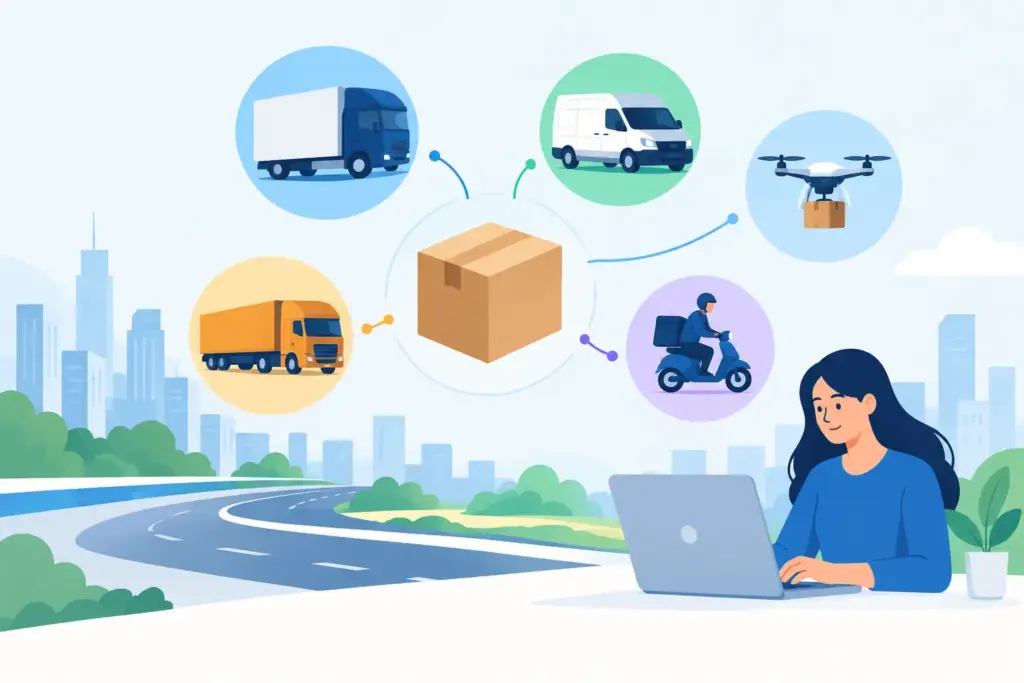
A carrier service failure at 4pm can quickly become a customer-service problem by 9am the next morning. For businesses shipping at scale, multi-carrier delivery technology changes that equation. Rather than leaving fulfilment teams to work around disconnected carrier portals, it creates one operational layer for choosing services, producing labels, tracking parcels and responding when delivery plans need to change.
That matters because parcel delivery is no longer a back-office function. It is one of the most visible parts of the customer experience. A missed delivery promise, an unclear tracking update or a difficult return can weaken the value built through every previous interaction with a brand. The right technology gives businesses more control over those moments without adding complexity to the warehouse floor.
Why single-carrier strategies reach their limits
A single carrier can be the right choice for a straightforward operation with predictable volumes, a narrow delivery footprint and a consistent service requirement. The challenge appears when the operation grows. Different destinations, product types, customer expectations and order profiles rarely fit one carrier’s strengths all of the time.
A next-day parcel to Manchester, a low-value packet to mainland Europe, a heavier consignment to a wholesale customer and a time-sensitive international order may each need a different approach. Relying on one network can mean paying for a service that is not the best fit, or having limited options when capacity tightens during peak.
Adding carriers manually is not the answer. Each new relationship can bring another booking portal, label format, invoice structure, tracking feed and collection process. Teams lose time switching between systems, while customer-service colleagues struggle to see a reliable picture of what is happening after despatch.
Multi-carrier technology is designed to remove this trade-off. It lets businesses broaden carrier choice while keeping the operational experience consistent.
What multi-carrier delivery technology actually does
At its core, a multi-carrier platform connects an order management system, warehouse management system or eCommerce platform with multiple carrier services through a single interface or integration. Orders flow in, shipping rules are applied, and the right label and service can be selected without staff moving from one carrier portal to another.
The practical value is not simply access to more carriers. It is the ability to make carrier choice operationally useful. A platform should turn delivery requirements into repeatable rules, so teams can act quickly without making every decision manually.
For example, rules might route parcels by destination, weight, dimensions, order value, delivery speed, product category or customer-selected service. A retailer could send UK standard deliveries through one service, assign remote postcodes to a better-suited alternative, and apply a tracked international service where visibility is essential. The process happens in the background, but the business retains control and can adjust the logic as trading conditions change.
A capable platform also centralises tracking events, delivery data, returns processing and reporting. This creates a clearer view of performance across the carrier estate, rather than a collection of separate reports that are difficult to compare.
The integration layer is where the value sits
Carrier contracts alone do not simplify delivery. The difference comes from the layer between a business’s systems and its delivery partners. When that layer is properly integrated, orders can move from checkout or warehouse release to label generation with fewer manual touches and fewer opportunities for error.
This is particularly valuable for brands with more than one fulfilment location, a mix of direct-to-consumer and business-to-business orders, or growing international demand. They need a delivery operation that supports expansion without requiring a new set of processes every time they add a market, warehouse or carrier service.
Team AGL’s Clearview platform is built around this principle: bringing carrier connectivity and operational logistics into one manageable workflow. The objective is simple – reduce supply-chain complexity while giving teams the flexibility to deliver the experience their customers expect.
Better delivery choice, not carrier overload
More choice only helps when it is governed well. A business does not need every available carrier service switched on from day one. It needs the services that solve genuine commercial and operational needs.
The strongest multi-carrier strategy usually starts with a small, purposeful carrier mix. One service may be ideal for domestic economy delivery; another may offer better support for premium options, difficult destinations or specific international lanes. As volumes and requirements evolve, the mix can evolve too.
This approach creates resilience. If a carrier experiences disruption, imposes a cut-off change or faces capacity pressure at peak, the business is less exposed. Shipping rules can be amended, alternative services activated and customers kept informed. That does not mean every parcel can be moved instantly or without cost implications. Carrier availability, collection schedules, parcel specifications and destination restrictions still matter. But businesses have options, which is far better than scrambling to build a contingency plan during an incident.
The commercial case goes beyond rate comparison
It is tempting to judge delivery performance by headline parcel rates alone. Cost matters, particularly when volumes are high, but the cheapest label is not always the lowest-cost delivery.
A service that produces more customer contacts, failed delivery claims or manual interventions can become expensive quickly. So can a workflow that needs staff to rekey information, reconcile multiple invoices and investigate parcels across several systems. Multi-carrier technology helps businesses assess the fuller cost of delivery by bringing operational and performance data into one place.
With that visibility, leaders can ask better questions. Which services are meeting their delivery promise? Where are surcharges rising? Which destinations generate the most exceptions? Are premium services being used where standard delivery would meet the customer need? Are returns creating avoidable cost or friction?
The answers support smarter decisions on carrier allocation, delivery propositions and customer communication. They also allow logistics to become a more active contributor to margin protection, rather than a cost centre that is reviewed only when something goes wrong.
What to look for in a multi-carrier platform
The right solution depends on the shape of the operation. A high-volume fashion retailer, a specialist parts supplier and an international consumer brand may all need multi-carrier capability, but their priorities will differ. Before selecting a platform, focus on whether it can support the way your business actually ships.
Look for the ability to:
- integrate with your existing eCommerce, order and warehouse systems without creating manual workarounds;
- automate service selection through rules that your operations team can understand and maintain;
- generate compliant labels, customs data and shipping documents for domestic and international movements;
- provide clear tracking and exception visibility for both operational and customer-service teams;
- handle returns in a way that matches your customer promise and internal processing requirements;
- scale across higher volumes, additional sites and new markets without forcing a platform replacement.
Operational support deserves equal attention. Technology can automate decisions, but logistics expertise is still needed when a service changes, a cross-border lane becomes more complex or a peak plan needs stress-testing. The best partners combine a strong platform with people who understand carrier networks, customs processes and the realities of running a despatch operation.
Data quality remains non-negotiable
No platform can compensate for incomplete addresses, inaccurate parcel weights or missing customs information. Multi-carrier technology can validate data, flag exceptions and standardise processes, but the business must also maintain good product, order and customer data.
This is especially true for international delivery. Commodity descriptions, values, harmonised codes and recipient information affect clearance and customer experience. A well-designed workflow reduces avoidable errors before parcels leave the warehouse, rather than leaving teams to resolve delays after they appear in tracking.
Turning delivery into a customer advantage
The end customer rarely cares which system produced a shipping label. They care whether the delivery choices are clear, the promised date is realistic, the parcel arrives as expected and the return process feels fair.
That is why multi-carrier capability should connect directly to the customer proposition. It can support a broader range of checkout options, more reliable delivery promises and better communication after despatch. It can also help brands tailor services by market, product or customer segment instead of applying one blanket approach everywhere.
There is a balance to strike. Too many delivery options can confuse customers and complicate fulfilment. The aim is not to display every carrier service at checkout. It is to offer a focused set of meaningful choices, backed by the flexibility to fulfil them consistently.
As parcel operations become more demanding, the businesses that perform best will not be those with the longest list of carrier accounts. They will be the ones with a clear delivery strategy, intelligent automation and the freedom to adapt when conditions change. That is how delivery stays dependable for your operation and memorable for the customers who rely on it.