
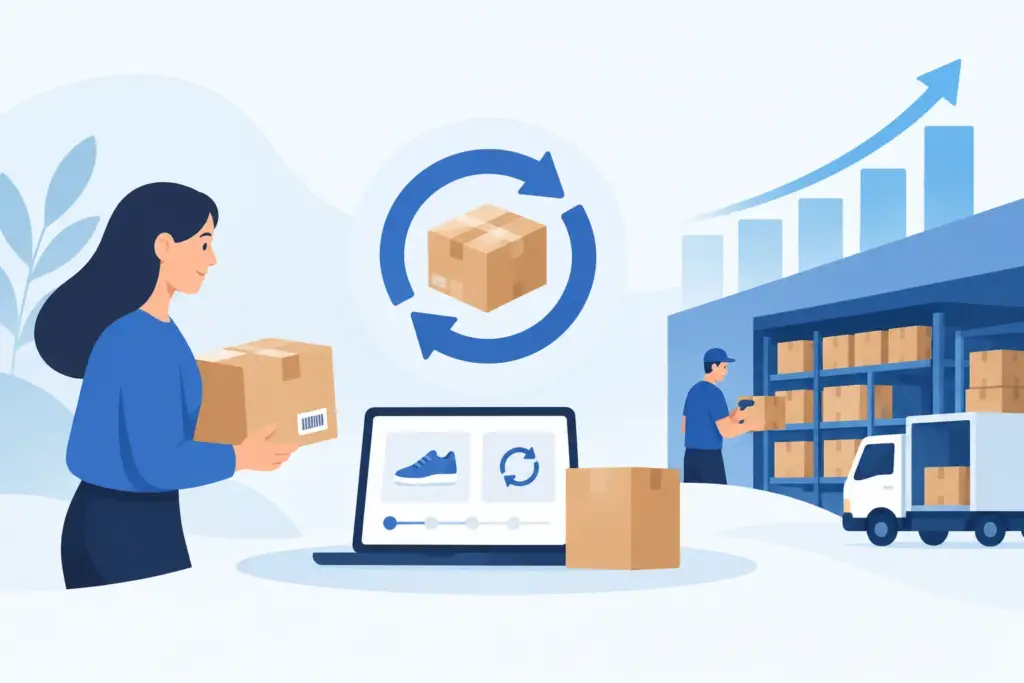
A customer has decided a product is not right for them. What happens next can either protect the sale or turn one return into a reason not to buy again. An ecommerce returns management solution brings the customer journey, carrier decision, warehouse process and refund status into one controlled workflow – so returns feel straightforward for shoppers and manageable for the teams behind the scenes.
For growing retailers, returns are not a back-office exception. They are a high-volume customer service moment, a transport cost, an inventory decision and a valuable source of trading insight. Treating them as a disconnected process creates avoidable friction: manual labels, inconsistent carrier choices, delayed refunds and limited visibility of why products are coming back.
Why returns need the same attention as delivery
Customers increasingly judge a retailer on how easily they can return an item, not only on how quickly it arrived. A complicated process can discourage repeat purchase, particularly in categories such as fashion, footwear, beauty and homeware where returns are an expected part of buying online.
Yet offering unlimited choice without operational control is not the answer. A generous policy can improve conversion, but it can also increase transport spend, encourage unnecessary ordering behaviour and leave warehouses handling unpredictable inbound volumes. The aim is not simply to make returns free or fast. It is to create a process that gives customers appropriate choice while helping the business control cost, speed and stock recovery.
That requires returns to sit within the wider delivery operation. The same business may need a drop-off option for a low-value domestic return, a collection service for a bulky item, and a different route for goods travelling back from Europe. When these choices are managed across separate portals and carrier contracts, operations teams lose time and consistency.
What an ecommerce returns management solution should connect
The strongest returns operation links four moving parts: the customer-facing return journey, carrier services, warehouse receipt and commercial data. If one is missing, the process soon becomes manual.
A customer journey that sets clear expectations
A return should begin with an easy, branded journey that explains eligibility, available return methods and likely processing times. Customers need to know whether they can use a printerless label, a local drop-off point or a collection, and whether the return is chargeable. Clear information reduces contact-centre queries before the parcel has even left their hands.
The right level of choice depends on the product and customer promise. A premium brand may prioritise home collection and a highly supported experience. A value-led retailer may guide customers towards cost-effective drop-off services. Neither approach is automatically better. The key is making a deliberate service decision rather than applying one expensive return method to every order.
Carrier choice built around the return, not habit
Returns have different service requirements from outbound deliveries. The fastest carrier is not always the right one, and the lowest headline price may create more customer contacts or slower stock recovery. A multi-carrier approach gives businesses the flexibility to select services by parcel size, destination, value, urgency and return route.
This matters even more for international trade. A cross-border return may require the correct paperwork, commodity information and a planned customs approach. If those details are left until a parcel is already moving, goods can be delayed, charged unexpectedly or become difficult to reconcile. Managing return data at the point of authorisation creates a far stronger foundation for cross-border control.
Warehouse visibility that speeds up stock decisions
A parcel being handed to a carrier is not the end of the return journey. Operations teams need visibility of when it is on its way, when it reaches the returns centre and whether the item can be resold, repaired, quarantined or disposed of.
Not every business needs instant refunds on first carrier scan. That approach can be right for trusted customers and lower-value goods, but it brings a fraud and margin risk. Other brands will wait for warehouse inspection, particularly for high-value, serialised or condition-sensitive products. A flexible solution supports the policy that fits the category while keeping customers informed at every stage.
Data that shows where margin is being lost
Return reasons should not disappear into a spreadsheet once a refund is issued. Size and fit patterns, inaccurate product descriptions, quality concerns, damaged parcels and carrier-related issues all point to different actions. The value comes from connecting return reason data with order, product, destination and carrier performance.
A high return rate is not always a failure. It may reflect a product category or a policy designed to remove purchase hesitation. What matters is whether the business understands the cost, customer behaviour and recoverable stock value behind that rate. Good reporting separates useful customer flexibility from avoidable operational loss.
Designing a returns process that works at volume
Start with the decisions that must be consistent, then automate them. That means agreeing the return window, item eligibility, customer-paid or retailer-paid rules, service options, refund trigger and treatment of exceptions. Without these policies, technology simply moves uncertainty around faster.
Once the rules are clear, an effective workflow can automatically validate an order, create the right label or QR code, notify the customer, select a carrier service and share return information with the warehouse. This removes repetitive administration while leaving teams able to intervene when a return falls outside policy.
There are several practical areas to get right as volumes grow:
- Match carrier services to parcel profile, customer location and the value of the goods rather than defaulting to one service.
- Give customers proactive tracking updates from authorisation through to refund or exchange confirmation.
- Create clear exception paths for unrecognised parcels, incomplete returns, damaged goods and expired return windows.
- Reconcile carrier scans, warehouse receipt and refund status so that finance, customer service and operations work from the same information.
- Use return reason trends to improve product pages, packaging, fulfilment accuracy and buying decisions.
The warehouse workflow deserves particular attention. A returns centre that receives parcels without advance data must identify the order, assess the item and update several systems before stock can be made available again. Pre-advised returns reduce this delay. They help teams plan labour, prioritise high-value goods and make stock decisions with fewer manual checks.
For businesses with multiple fulfilment locations, routing is equally important. Sending every return to a single site may simplify administration, but it can extend transit time and create unnecessary inbound transport costs. Routing closer to the best inspection, refurbishment or resale location can improve recovery, although the model must still be simple enough for customers to understand.
Choosing the right technology and logistics partner
An ecommerce returns management solution should not become another standalone portal for teams to check. Look for technology that fits into the existing commerce, warehouse and customer service environment, while giving access to the carrier services required across the UK and international markets.
Integration capability matters because return information must travel in both directions. Orders and customer details should be available when a return is requested. Tracking events should update the customer journey. Warehouse receipt should inform the refund or exchange decision. Reporting should bring together the operational and commercial picture.
Carrier breadth also has to be useful, not just extensive. Ask whether the available network supports the actual returns needs of the business: convenient drop-off coverage, collection options, parcel size limits, international return routes and clear tracking events. The best solution gives teams a practical choice at the point of dispatch, rather than leaving them tied to one carrier when circumstances change.
Team AGL’s Clearview platform is designed to reduce this complexity by bringing multi-carrier parcel activity into a central workflow. For businesses managing domestic and cross-border returns alongside outbound deliveries, that means less time switching between systems and more control over the customer experience.
Measure success beyond the return rate
Return rate is useful, but it is only one measure. A lower rate achieved by making returns difficult may damage customer lifetime value. A better view combines cost per return, time from request to carrier handover, transit duration, time to warehouse decision, refund speed, resale recovery and repeat purchase behaviour.
Review those measures by product, channel, region and carrier. A pattern that is hidden in the overall figure may be obvious when broken down: one product may have misleading sizing, one market may need a different return service, or one carrier route may be creating avoidable delays. This is where operational data becomes a commercial advantage.
The right process will continue to evolve with customer expectations, product mix and trading geography. Start by making the next return easier to authorise, track, receive and resolve. Each improvement builds a more controlled operation – and gives customers a reason to come back with confidence.