
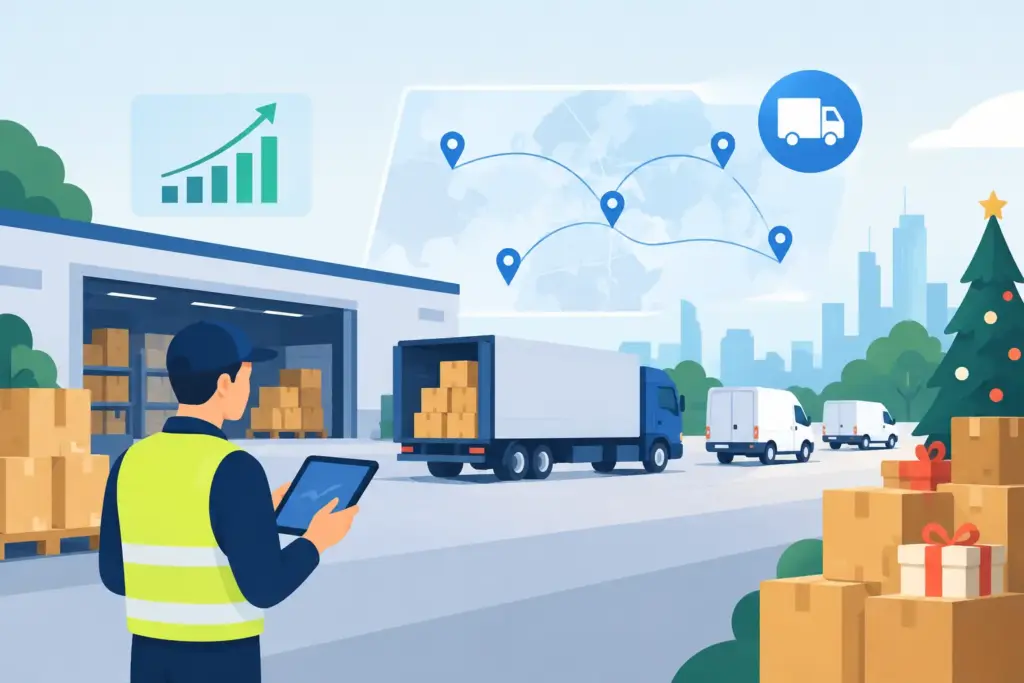
Peak volume rarely creates just one problem. A late collection can create a backlog at the packing bench, a carrier capacity issue can force costly service changes, and one unclear tracking update can become a surge in customer contacts. To optimise peak season dispatch, businesses need to manage the whole delivery operation as one connected workflow – not a series of last-minute courier decisions.
For high-volume retailers, wholesalers and consumer brands, peak planning is not simply about processing more parcels. It is about preserving choice, control and customer experience while order profiles become less predictable. The strongest operations prepare early, but they also build the flexibility to respond when the plan meets reality.
Optimise Peak Season Dispatch Before Volumes Arrive
The first useful question is not, “Which carrier should we use?” It is, “What will our parcel mix look like under pressure?” Review historic peak periods alongside current trading plans, campaign calendars and product launches. A promotion that shifts demand towards heavier items, higher-value orders or remote destinations can change carrier requirements significantly.
Look beyond total parcel volume. Map dispatch by destination, service type, parcel dimensions, cut-off time and expected day-of-week pattern. International orders need their own forecast, particularly where customs documentation, duties handling or local delivery expectations can affect transit times. Returns should be included too. A successful sales event can create a material reverse-logistics workload a few weeks later.
Forecasting will never be perfect. Its value lies in giving carriers, warehouse teams and customer service colleagues a credible operating range. Plan for expected demand, but model a higher-volume scenario and agree what changes when that threshold is reached. That might mean opening an additional packing station, switching selected postcode areas to another service, or extending collection capacity.
Turn service promises into operational rules
Peak creates risk when marketing messages, website delivery options and warehouse cut-offs are managed separately. Every promise shown at checkout needs a clear operational route behind it.
Set rules for which services appear by stock location, order value, basket type, destination and time of day. For example, next-day delivery may be commercially valuable for domestic orders placed before a defined cut-off, while a tracked economy service may be the right choice for lower-value items or non-urgent destinations. The objective is not to push every parcel into the fastest service. It is to offer the right level of service with confidence.
These rules should be reviewed daily during the busiest period. If a carrier experiences disruption, a static checkout promise can quickly become expensive. Flexible service configuration allows the business to protect delivery performance without asking technical teams to rebuild workflows each time conditions change.
Build Carrier Choice Into Peak Season Dispatch
A single-carrier strategy can work for stable volumes and a simple delivery profile. During peak, it can also create a single point of failure. Capacity constraints, localised disruption, weather events and network backlogs do not always affect every carrier in the same way.
Multi-carrier delivery gives operations teams options, but only if those options are practical to use. Running separate carrier portals, label formats and billing processes can replace one problem with another. The operational advantage comes from centralising carrier access and applying intelligent routing rules through one workflow.
A platform such as Clearview can connect fulfilment operations to multiple carrier services while keeping label generation, tracking and reporting in one place. That means teams can route orders by service level, destination, cost, parcel characteristics or agreed contingency rules without manually rekeying shipment data across systems.
Carrier diversification has trade-offs. More choice needs governance. Do not add services simply because they are available. Assess each option against collection reliability, network coverage, claims processes, scan quality, peak capacity, delivery performance and the experience it creates for the recipient. A lower rate can be false economy if it generates avoidable “where is my order?” contacts or repeat delivery failures.
Agree contingencies before you need them
A peak contingency plan should be specific enough to use at 4pm on a busy Friday. Define who can authorise carrier changes, which orders can be rerouted, whether delivery charges change, and how customers will be informed if a selected service is temporarily unavailable.
It should also cover the warehouse floor. If labels for a service change, can colleagues identify the correct parcel lane immediately? If collections run late, where will completed parcels be held securely? If volumes exceed the planned manifest, is an additional collection available? These are small details until they are the reason orders miss the network.
Remove Friction From the Despatch Bench
Peak performance is often won or lost in seconds. Repeated address checks, manual carrier selection, separate label screens and unclear exception handling each add time to every order. At volume, that time becomes a queue.
Automate the decisions that do not need human judgement. Order data should flow from the sales channel or order management system into the shipping workflow, where agreed rules select the appropriate carrier service and generate the shipping label. Address validation, customs data prompts and dangerous goods checks, where relevant, should happen before a parcel reaches the final packing stage.
Automation does not mean removing people from the process. It gives them more time for the work that needs judgement: resolving an incomplete address, choosing an appropriate service for a sensitive order, or identifying a spike in failed labels before it affects hundreds of consignments.
Create a simple exception path. Teams need to know what to do when a label does not generate, a postcode is unsupported, customs information is missing or a collection allocation is at risk. The best process directs exceptions to the right person quickly and records the reason. That data exposes recurring issues that can be fixed before the next trading peak.
Use Visibility to Protect the Customer Experience
Customers do not judge a delivery operation by the complexity behind it. They judge it by whether the parcel arrives when expected, whether tracking is clear and whether help is available when something changes.
That makes proactive visibility commercially valuable. Track operational measures such as orders released to despatch, labels produced, parcels manifested, collection completion, first carrier scan and delivery exception rates. A parcel marked as despatched but not scanned into a carrier network may need attention long before a customer notices.
Share the right view with the right team. Warehouse managers need to see throughput and cut-off risk. Logistics teams need carrier and lane performance. Customer service needs accurate tracking status and a clear escalation route. Senior leaders need to understand whether service costs, delivery promises and performance are moving in the right direction.
The most useful reporting is not necessarily the most detailed. During peak, focus on measures that drive action: missed cut-offs, uncollected parcels, label errors, delayed first scans, failed delivery attempts and contact rates by carrier service. Review them in a short daily operational rhythm, then make a decision while there is still time to influence that day’s despatch.
Treat Returns as Part of the Peak Plan
Returns are often planned after outbound delivery, even though they affect stock availability, customer loyalty and warehouse capacity. If the business expects gifting, seasonal sizing purchases or high-volume promotional sales, returns volumes should be forecast alongside despatch.
Give customers a straightforward returns route, clear instructions and suitable service options for the product value and destination. Internally, make return labels and tracking visible within the same operational view as outbound parcels. This helps customer service respond accurately and lets teams identify recurring product, packaging or carrier issues.
There is a balance to strike. A generous returns experience can support conversion and loyalty, but it should not create unnecessary cost or complexity. Rules based on product type, reason for return and customer location can provide choice while keeping the process commercially controlled.
Keep Improving While Peak Is Live
Peak plans should not sit in a document until January. Use live data to adjust cut-offs, routing rules, staffing patterns and carrier allocation as demand develops. A campaign may perform above expectations in one region, while an overseas service may need earlier customer messaging because of customs or network conditions.
After the busiest trading days, capture what changed and why. Which carrier contingency was used? Where did manual work increase? Did customers choose the delivery options you expected? Which exceptions caused the most delay? These answers turn peak from an annual scramble into a more capable operation each time it returns.
The goal is not merely to despatch more parcels. It is to make every busy day feel more controlled for your team and more reliable for your customers – even when demand refuses to follow the forecast.