
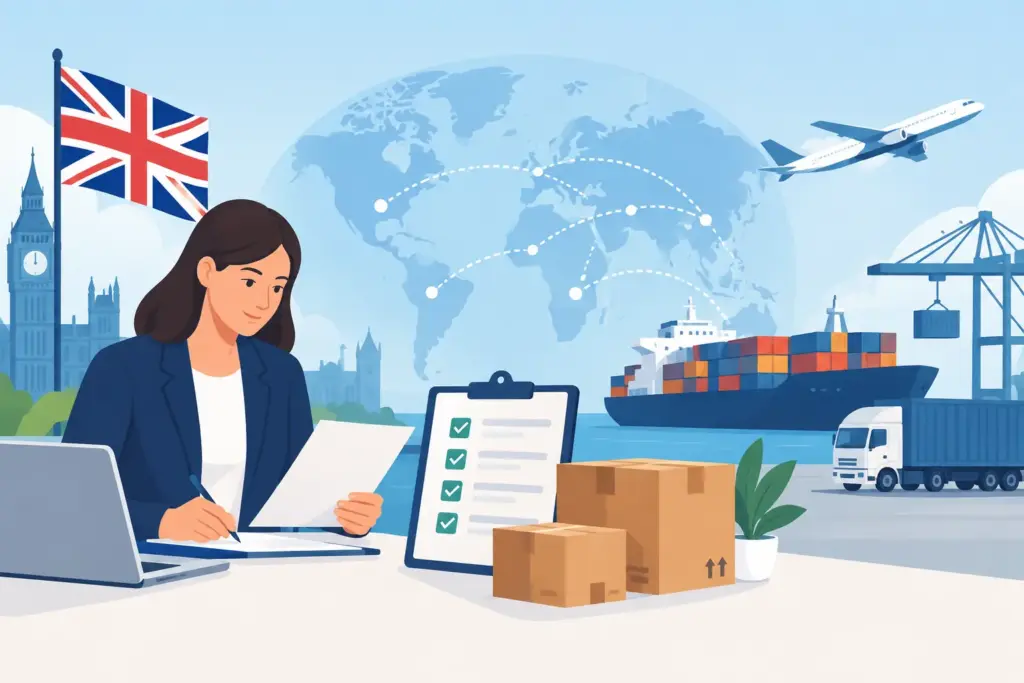
An export declaration is not an administrative extra added after a parcel has left the warehouse. It is the customs record that tells authorities what is moving, where it is going, who is responsible and whether it can legally cross the border. This export declarations guide is designed for UK businesses that want international delivery to feel as controlled as their domestic operation.
For high-volume retailers, wholesalers and consumer brands, the challenge is rarely sending one parcel overseas. It is maintaining accurate, repeatable customs data across thousands of orders, multiple destinations and different carrier services. Get the data right at source and cross-border delivery becomes faster, easier to track and far less likely to create a poor customer experience.
What an export declaration does
An export declaration is submitted to customs when goods leave Great Britain for another customs territory. It provides the information HMRC and destination customs authorities need to assess controls, duties, taxes and trade statistics.
The declaration may be made by the exporter, a freight forwarder, a customs agent or a carrier, depending on the service and agreed responsibilities. That does not remove the exporter’s obligation to ensure the information is correct. If a commodity code, value or product description is wrong, the business named on the declaration may still face delays, additional costs or compliance questions.
For parcel shippers, the declaration is often created from data captured in the shipping platform. This is why customs performance is closely tied to fulfilment workflow. A label can be generated in seconds, but it only supports a clean border crossing when the underlying product and order data is complete.
Export declaration, commercial invoice and shipping label
These documents and data sets work together, but they are not interchangeable.
A shipping label directs the parcel through the carrier network. A commercial invoice sets out the sale and the goods’ value for the buyer, carrier and customs authorities. The export declaration is the formal customs submission made to export the goods.
Depending on the destination, goods and carrier service, you may also need a packing list, proof of origin, licences or certificates. Treating a commercial invoice as the whole customs process is a common and costly mistake, particularly as volumes grow.
Export declarations guide: the data you need
The strongest export operations do not ask warehouse teams to interpret customs rules order by order. They create a reliable product-data foundation, then apply it consistently through their order management, warehouse and multi-carrier systems.
Start with a valid GB EORI number. A business generally needs one to move goods between Great Britain and other territories. Your overseas importer may also need its own local registration or tax number, especially where duties and taxes are collected on import.
Every product should have a clear, specific description. “Clothing”, “parts” or “gift” do not provide enough detail for customs assessment. A useful description states what the item is, what it is made from and, where relevant, its purpose. “Men’s knitted cotton jumper” is much more useful than “jumper”.
Commodity codes are equally important. They classify products for customs purposes and influence duty treatment, restrictions and statistical reporting. Similar products can sit under different codes depending on material, construction, use or value. Do not rely on a broad category copied from an old invoice. Review codes when the product range changes, and seek specialist advice for goods that are technical, regulated or difficult to classify.
You will also need accurate values. Customs value is not always simply the website selling price. The correct basis can depend on the transaction, freight, insurance, discounts and the Incoterms agreed with the buyer. Values that look artificially low can trigger scrutiny, while inconsistent values create disputes and slow clearance.
Country of origin deserves the same attention. Origin usually means where a product was made or sufficiently processed, not where it was shipped from. This distinction matters where a trade agreement may reduce or remove duties. A UK dispatch address does not automatically make goods UK origin.
For each shipment, capture the exporter and importer details, recipient address and contact information, quantity, weight, currency, reason for export and delivery terms. Small omissions can result in a parcel sitting in a customs facility while the carrier seeks clarification.
Decide who pays duties and taxes before dispatch
The commercial decision behind a shipment matters as much as the declaration itself. Businesses typically choose whether the recipient will pay import charges on arrival or whether the seller will collect and cover them as part of the purchase journey.
If the recipient is expected to pay, the customer should understand that before checkout. Unexpected duty requests are a leading cause of refused parcels, avoidable returns and frustrated support teams. If the seller covers charges, the business needs a carrier and customs set-up that supports that model, alongside clear visibility of the landed cost.
There is no single right approach. Delivered-duty-paid style arrangements can improve the customer experience for premium brands and repeat-purchase markets, but they require more operational control and cost management. Recipient-paid services may suit lower-value or occasional international orders, provided communication is transparent.
Incoterms help define the responsibilities of seller and buyer, but they should not be selected as a box-ticking exercise. Make sure the sales, finance, fulfilment and customer-service teams all understand what the chosen terms mean in practice.
Build declarations into your fulfilment workflow
Manual customs entry may be manageable at low volumes. It becomes a weak point when multiple team members are copying data between ecommerce platforms, spreadsheets, carrier portals and invoices. The risks are obvious: inconsistent descriptions, missing origin data, incorrect values and dispatches held for review.
A connected workflow changes the process. Product data should flow from the source of truth into the shipping process, with controls that flag missing or implausible information before a label is produced. Carrier selection should account for destination capability, transit expectation, service level and customs model, not just the headline delivery price.
This is where multi-carrier technology can make a practical difference. Instead of asking teams to manage separate rules and portals for each carrier, a central platform can standardise data capture while applying the right carrier service to the order. Team AGL’s Clearview platform is built to bring that carrier connectivity, shipping workflow and delivery visibility into one operational view.
Automation is valuable, but it is not a substitute for governance. Set ownership for commodity codes, origin statements, product descriptions and customs-value logic. Give warehouse teams a route to stop and query unusual orders. Monitor the exceptions that recur, because they often reveal a product-data or checkout issue that can be fixed once rather than handled repeatedly.
Know when extra controls apply
Some exports need more than standard parcel data. Controlled goods, dual-use items, military products, alcohol, food, plants, animal products, chemicals, medical devices and branded goods subject to intellectual-property restrictions can have additional requirements. Sanctions and denied-party screening also matter, particularly for businesses selling to a wide range of markets.
Do not assume a low-value parcel is exempt from control simply because it is small. Value can affect duty and tax treatment, but product restrictions are often based on the nature of the goods and the destination.
Northern Ireland requires particular care because its goods-movement arrangements differ from Great Britain’s trade with many other markets. The right process depends on the direction of movement, the goods and the parties involved. Where the route is not straightforward, get current customs advice before building it into a standard shipping rule.
Reduce delays with a practical pre-dispatch check
Before international orders leave the warehouse, your process should confirm that the exporter and importer details are valid, goods descriptions are specific, commodity codes and origin are assigned, values are credible and the duties-and-taxes model is clear. It should also identify whether licences, certificates or destination-specific documents are needed.
A useful measure is not just how many parcels are dispatched, but how many clear customs without intervention. Track clearance holds, requests for additional information, refused deliveries, duty disputes and returns by destination, product type and carrier. This data gives operations leaders a clear view of where friction begins.
The goal is not to make every export declaration more complicated. It is to make the right information available once, apply it consistently and give your team the confidence to ship internationally at pace. When customs data is treated as part of the customer journey, rather than a final warehouse task, global growth becomes much easier to scale.