
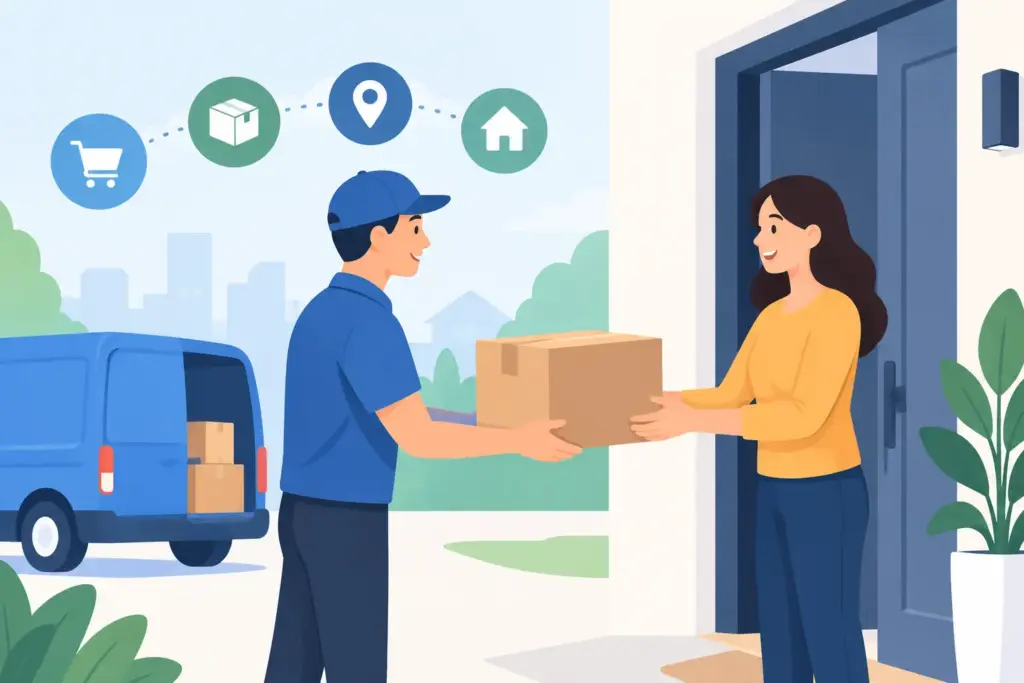
A customer can forgive a product arriving in plain packaging. They are far less forgiving when its delivery date changes without warning, their preferred option is unavailable, or a return becomes a chase. To improve ecommerce delivery experience, retailers need to treat fulfilment as part of the customer journey – not a final operational hand-off after the sale.
For high-volume brands, delivery is where commercial promise meets operational reality. The checkout choices, carrier performance, tracking messages and returns process all shape whether a customer buys again. Getting this right requires more than finding the lowest parcel rate. It requires a delivery operation built around choice, visibility and the ability to respond when conditions change.
Start with the delivery promise, not the carrier contract
The strongest delivery strategies begin with what customers genuinely need. A customer buying a birthday gift may value a precise delivery window. Someone replenishing an everyday product may prefer a low-cost option or a collection point near work. International shoppers want clear expectations around transit times, duties and tracking before they commit to an order.
That means the right delivery offer will vary by product, destination, order value and customer segment. Next-day delivery may be commercially essential for some UK orders, while an economy service is the sensible choice for lower-value parcels. Large or fragile goods may need specialist handling. A single service level for every order can look simple internally, but it often creates unnecessary cost and a poorer customer proposition.
Map the delivery journey from checkout to post-delivery support. Look for the moments where customers lack control or information: unavailable delivery dates, vague estimated arrival times, difficult changes of address, missed deliveries and unclear returns instructions. These are the friction points most likely to turn a successful sale into a support query.
Give customers meaningful delivery choice
Choice works when it is useful, not when it overwhelms. Two or three well-presented options are usually more effective than a long list of carrier services with unfamiliar names. Be clear about the price, expected delivery date and any cut-off time. If a service is not available for a particular postcode, product or destination, remove it rather than presenting a promise you cannot keep.
A balanced checkout proposition often includes an economical option, a faster service and an out-of-home alternative such as collection or locker delivery. The exact mix depends on your customer base. Fashion brands with frequent returns may see strong uptake for convenient collection points. Premium goods may benefit from tracked, signed-for services. Businesses selling internationally must also account for local delivery preferences, which can differ significantly from UK expectations.
Choice also gives the operation room to manage disruption. If one carrier experiences capacity constraints or a regional service issue, a multi-carrier model creates alternatives without forcing the business to redesign its checkout process overnight. That agility protects revenue as well as customer confidence.
Make delivery dates credible
A delivery estimate is a promise in the customer’s mind. It should reflect order cut-off times, warehouse processing capacity, non-working days, service availability and the destination postcode. Over-promising to win a conversion and missing the date afterwards is rarely a worthwhile trade-off.
Use the most accurate data available at checkout and update it when an order is despatched. During peak trading periods, it is better to communicate a realistic date than rely on a generic next-day message that the operation cannot consistently fulfil. Reliability builds trust; speed only builds trust when it is delivered.
Improve ecommerce delivery experience through visibility
Once a parcel leaves the warehouse, silence creates uncertainty. Proactive tracking turns that gap into a managed customer experience. It reduces the number of “where is my order?” contacts while giving the customer confidence that their parcel is moving as expected.
Tracking communications should answer practical questions: has the order been despatched, when is it likely to arrive, can the recipient make changes, and what should they do if delivery is missed? A clear delivery notification can be just as valuable as a faster transit time, particularly for orders that require someone to be present.
The operational team needs a broader view than the customer. They need to see exceptions across every carrier, identify delayed consignments early and intervene before a complaint lands. This is where disconnected carrier portals become a real drag on service. Logging into multiple systems, reconciling tracking formats and manually chasing failures consumes time that should be spent solving the customer issue.
A centralised multi-carrier platform gives teams one view of shipments, labels, manifests and delivery events. Team AGL’s Clearview platform is designed to bring those moving parts into one workflow, helping merchants retain carrier choice while giving operations teams the visibility to act quickly.
Build exception management into the operation
Even the best delivery network will encounter disruption. Weather events, traffic, customs holds, incomplete addresses and failed delivery attempts are part of parcel logistics. The differentiator is not whether an exception occurs, but how quickly it is identified, communicated and resolved.
Set clear ownership for common failure points. If a parcel has not received an expected scan, who investigates? If an address is incomplete, how is the customer contacted? If an international shipment is held for customs information, does the process prompt the right action before the parcel is returned?
Use service data to distinguish one-off incidents from recurring problems. A rise in missed deliveries in a specific region, a growing number of damage claims or repeated customs delays on one route should trigger a review of the service, packaging, carrier allocation or product data. Good reporting is not about producing more dashboards. It is about making better decisions before small issues become expensive patterns.
Treat returns as a second delivery experience
Returns are often where a carefully designed outbound journey falls apart. Yet for many ecommerce sectors, especially fashion, beauty and consumer goods, the return process is a major factor in whether customers purchase again.
Make the process easy to understand before the customer needs it. Explain the return window, condition requirements, costs and available handover options in plain language. Digital return labels or paperless options can reduce friction, while convenient drop-off locations make the process more practical for customers who are not at home during the day.
There is a commercial balance to strike. Free returns may support conversion and loyalty, but they can increase avoidable costs if the policy is too open-ended. Paid returns can discourage low-intent purchases, but may also damage customer perception if they feel unexpected. The right policy depends on margin, category behaviour and the reason for return. What matters most is that the process is transparent and that the returned item can be tracked back into stock or assessed quickly.
Connect delivery technology to fulfilment reality
Delivery experience cannot be improved in isolation from warehouse operations. The most persuasive checkout message means little if orders are released late, stock data is inaccurate or labels are created through manual workarounds.
Integrating order management, warehouse processes and carrier services reduces repetitive tasks and creates cleaner data across the journey. Automating service selection rules can ensure the right carrier is chosen based on destination, parcel dimensions, value or required delivery speed. It also reduces reliance on individual knowledge at busy times, when consistency matters most.
However, automation should not be left unchecked. Review allocation rules regularly, especially when carrier pricing, service performance or customer demand changes. The cheapest route is not always the best value if it creates more contacts, claims or lost repeat orders. A good delivery operation measures total cost to serve, not just the cost printed on a shipping label.
Measure what customers actually feel
Carrier on-time performance is essential, but it is only one measure. Pair it with delivery-related contact rates, first-attempt delivery success, tracking engagement, return cycle time, claims, customer feedback and repeat purchase behaviour. Together, these indicators show whether the operation is supporting the brand promise.
Segment the data by carrier, service, destination, product type and trading period. An overall average can hide a poor experience for a valuable customer group or a particular international market. Use those insights to test improvements: a clearer checkout message, different collection-point coverage, revised packaging or a change to service allocation.
The aim is not to create a perfect delivery journey for every possible scenario. It is to create a dependable system that gives customers clear choices, keeps them informed and helps your team recover quickly when the unexpected happens. Every parcel is an opportunity to prove that your brand is as easy to deal with after checkout as it was before it.