
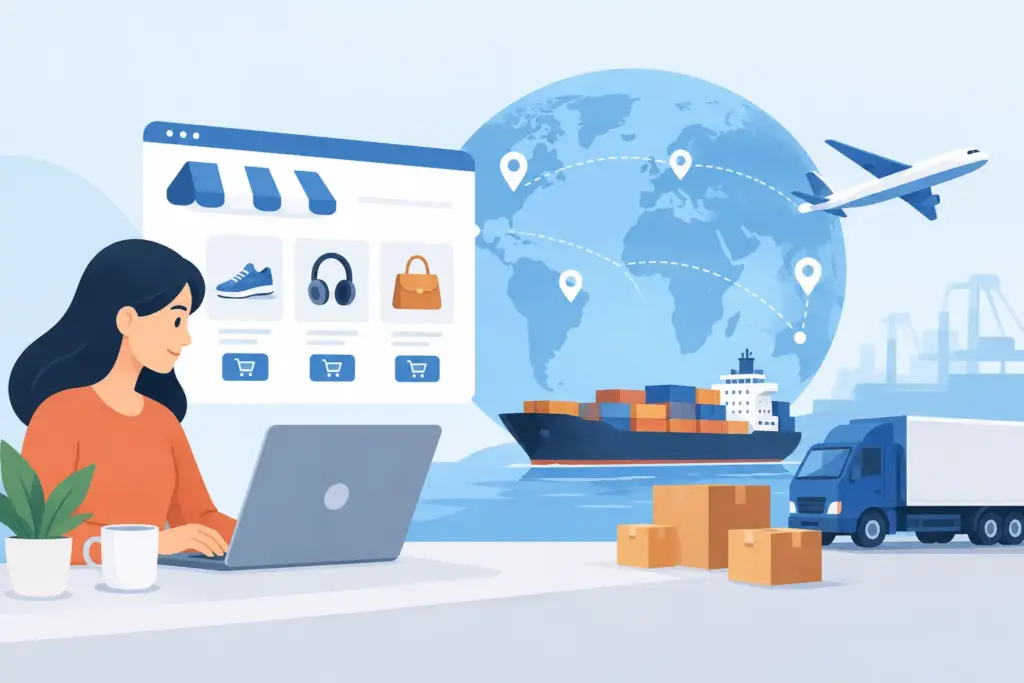
A customer in Paris sees a £120 order at checkout, pays for delivery, then receives a request from customs for VAT, duty and a handling fee. The parcel may still arrive, but the experience has already fallen short. For cross-border retail, the question of which incoterm suits online retailers is not paperwork for the shipping desk alone. It shapes conversion, margin control, customer service workload and whether a buyer chooses to order again.
For most direct-to-consumer brands, the practical choice comes down to DDP or DAP. Neither is automatically right. The better fit depends on where you sell, the value and nature of your goods, your ability to manage tax and duty, and the delivery promise you make at checkout.
Why Incoterms matter in eCommerce
Incoterms are internationally recognised trade terms published by the International Chamber of Commerce. They allocate responsibilities between seller and buyer for transport, export and import customs formalities, costs and risk at defined points in a shipment’s journey.
They do not replace a sales contract, determine who owns the goods, or solve every tax obligation. They also cannot override consumer protection rules in the market where you sell. But they provide a clear operational framework. That clarity matters when thousands of parcels are moving across borders through multiple carriers and customs systems.
In a business-to-business shipment, both parties may be comfortable arranging their own parts of the journey. In a consumer order, the buyer generally expects the retailer to make delivery straightforward. Asking a shopper to interpret a duty bill after they have paid can create refused parcels, return costs and avoidable contact-centre demand.
Which incoterm suits online retailers selling direct to consumers?
DDP: the strongest choice for a frictionless customer journey
Delivered Duty Paid, or DDP, places the greatest responsibility on the seller. The retailer arranges carriage, completes export and import clearance, and pays applicable duties and import taxes. Risk remains with the seller until the goods reach the named destination, ready for unloading.
For a retailer promising a fully landed price, DDP is usually the closest match. Customers know what they are paying at checkout and are not surprised by a payment request before delivery. This is particularly valuable for premium brands, repeat-purchase categories and markets where a poor delivery experience can quickly damage trust.
DDP gives the merchant more control, but it demands operational readiness. You need reliable product data, accurate commodity codes, declared values and country-of-origin information. You also need a viable way to calculate duties and taxes, appoint the correct importer of record where required, and reconcile costs that may vary by destination and product.
The margin risk is real. If duty estimates are inaccurate or a product is incorrectly classified, the retailer absorbs the difference. DDP is therefore most effective when it is supported by clean catalogue data, tested customs processes and delivery technology that can apply the right service and rules to each order.
DAP: lower seller exposure, higher customer friction
Delivered at Place, or DAP, means the seller delivers the goods to the agreed destination, but the buyer is responsible for import clearance, duties and import taxes. Risk transfers when the shipment is placed at the buyer’s disposal on the arriving vehicle, ready for unloading.
DAP can be appropriate for lower-volume international sales, markets where duty is difficult to predict, or product categories where the buyer is accustomed to handling import charges. It can also protect a retailer from carrying uncertain destination-country tax liabilities.
The trade-off is customer experience. If a consumer has not been clearly told that import charges are due, they may decline to pay. The parcel can then be delayed, returned or abandoned, with transport and administrative costs still landing back with the retailer. A low delivery price can look attractive at checkout, only to become expensive once failed deliveries and customer contacts are counted.
If you use DAP, make the position unambiguous before payment. Explain that local duties, taxes and carrier clearance fees may apply, and avoid language that suggests all costs are included. Transparency will not remove every objection, but it prevents the sense that an unexpected charge has been introduced after the sale.
FCA: useful for supplier and fulfilment relationships, not checkout promises
Free Carrier, or FCA, is often useful earlier in the supply chain rather than for a retailer’s final-mile consumer delivery. Under FCA, the seller clears goods for export and hands them to the carrier or another party nominated by the buyer at an agreed place. Risk transfers at that handover point.
For example, FCA may suit a brand buying stock from an overseas manufacturer and arranging its own freight, or a wholesale customer collecting from a fulfilment location. It can give both commercial parties a clear handover point.
For standard DTC orders, FCA rarely supports the experience customers expect. It shifts too much transport responsibility to the buyer and leaves too much scope for confusion. Use it where the buyer has genuine logistics capability, not as a default for parcels sent to individual shoppers.
Other terms worth understanding
CIP and CPT can be relevant when goods are moving between businesses and the seller is arranging carriage to a named destination. CIP includes insurance, while CPT does not. In both cases, however, risk transfers to the buyer when goods are handed to the first carrier, not when they arrive. That distinction can surprise teams who assume paying for carriage means retaining transit risk.
EXW is usually a poor choice for export-focused online retailers. Ex Works asks the buyer to collect goods from the seller’s premises and handle export formalities. It may look simple for the seller, but it creates control and compliance gaps, especially when the buyer is a consumer in another country.
FOB, CIF, CFR and FAS are maritime terms designed for sea or inland waterway transport. They are commonly used incorrectly for containerised freight and are not the natural answer for parcel delivery. For eCommerce teams, using the right term for the transport mode is as important as choosing who pays the duty.
Choose the term around the promise you make at checkout
The best Incoterm should follow your commercial model, not dictate it. Start with the customer promise. If your proposition is simple international shopping with all charges paid, build for DDP and price the landed cost properly. If you are testing new overseas markets or selling products with difficult duty treatment, DAP may provide a sensible interim route, provided your checkout and communications are explicit.
Then assess the operational detail. Consider where your stock is held, who will act as importer of record, whether you have local VAT or sales tax registrations, how returns will be processed, and what happens when a customer refuses a parcel. Returns deserve particular attention: a DDP outbound shipment does not automatically make the return journey straightforward. The return movement may need its own customs instructions and evidence to avoid duties being charged again.
Product type matters too. Apparel, cosmetics, food supplements, electronics and alcohol can all carry different documentary, tax or regulatory requirements depending on the destination. A term that works well for accessories sent to Ireland may be unsuitable for regulated goods moving to Switzerland or the United States.
Make Incoterms operational, not theoretical
An Incoterm only works when it is reflected consistently across your workflow. Your checkout, commercial invoice, shipping label data, carrier service selection and customer emails should all support the same delivery model. If one system marks an order as DDP while a carrier manifest is sent as duties unpaid, the result is delay and confusion.
This is where a connected multi-carrier approach earns its place. Retailers need the freedom to select services by destination, speed, parcel profile and duty model without creating separate processes for every carrier. Clearview helps teams centralise those decisions, automate shipping data and maintain visibility as orders move from collection through to delivery and returns.
Before launching or changing an international service, test real order scenarios. Include high and low values, multiple products in one parcel, a return, a remote-area delivery and a refused shipment. The aim is not just to confirm that labels print. It is to prove that costs, customs data and customer communications hold up when the journey is less than perfect.
A practical default for growing retailers
For established DTC routes with sufficient volume and predictable customs costs, DDP is often the strongest commercial choice because it removes friction from the buyer’s journey. For new, complex or higher-risk destinations, DAP can be a sensible starting point while you build demand data and local compliance capability. FCA belongs more naturally in supplier, wholesale and freight arrangements than in consumer checkout.
The right answer can change as a market grows. Treat Incoterm selection as part of your international delivery strategy, review it alongside carrier performance and landed-cost data, and let the customer experience guide the next decision.