
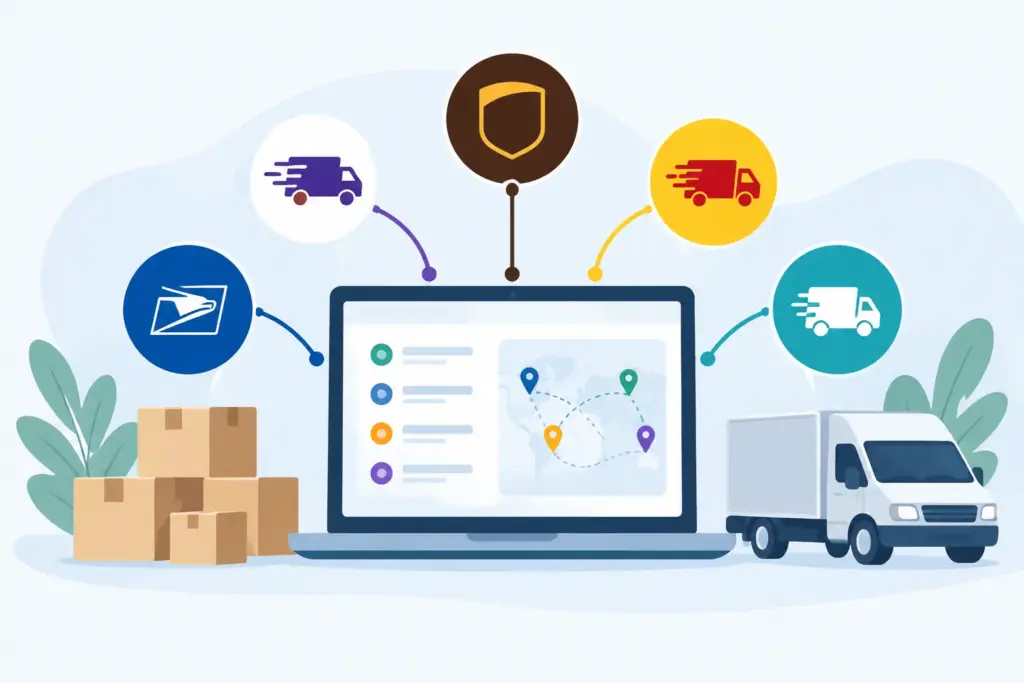
A single carrier can be the right answer – until a service disruption, peak-season capacity constraint or cross-border requirement exposes the limits of relying on one network. Businesses that integrate multiple delivery carriers can protect service levels while giving customers more choice at checkout and operations teams more control behind the scenes.
The challenge is not simply adding more courier accounts. Without the right technology and operating model, every additional carrier can create more labels, portals, invoices, exceptions and customer-service queries. The objective is to create one connected delivery workflow that makes carrier choice easier, not another layer of complexity.
Why integrate multiple delivery carriers?
Delivery has become a defining part of the customer experience. A shopper may forgive a product being temporarily unavailable; they are much less likely to overlook a late parcel, poor tracking or difficult returns process. For B2B shippers, the same principle applies in a different form: missed delivery windows, unreliable international transit times and limited shipment visibility quickly affect customer confidence and commercial relationships.
A multi-carrier strategy gives businesses options. One carrier may be the strongest fit for next-day UK parcels, another for economy services, another for European road movements, and another for time-sensitive international delivery. The best choice changes by destination, parcel size, delivery promise, product value and current carrier performance.
That flexibility matters most when conditions change. Carrier networks have planned and unplanned constraints. Volumes rise sharply around promotional events and the Christmas peak. Weather, industrial action, customs changes and regional capacity can all affect a route. If shipping decisions depend on a single provider, a localised issue can become a customer-wide problem.
There is a commercial benefit too. Multiple carrier options create a more informed procurement position, but price should not be the only measure. A lower unit rate can be outweighed by higher claims, failed deliveries, manual administration or increased contact-centre demand. The right model considers total delivery cost alongside transit performance and customer outcomes.
The difference between access and integration
Having contracts with several carriers is not the same as having an integrated multi-carrier operation. Many growing businesses reach a point where their warehouse team is logging into separate portals, comparing service tables manually and switching between label formats. It works for a while, but it is difficult to scale and leaves too much room for inconsistent decisions.
A proper integration brings carrier services into one operational layer. Order and parcel data enters once, business rules select an appropriate service, labels are produced from a common workflow, and tracking events return to a shared view. This removes repetitive admin while allowing teams to make delivery choices based on current operational needs.
For a retailer, that may mean presenting standard, express and collection-point options without manually managing each carrier connection. For a wholesaler, it may mean applying agreed service rules by customer account, postcode or product type. For an international brand, it can mean generating the correct shipping documentation and applying country-specific rules before a parcel reaches the despatch bench.
The technology must support the operating reality, not force the operation to work around it. That includes collection times, cut-off times, parcel dimensions, hazardous or restricted goods, customs data, returns routes and the actual capabilities of each carrier service.
Start with the delivery decisions that matter
Before choosing a platform or building an integration, map how delivery decisions are made now. The most useful question is not, “Which carriers do we want?” It is, “Which delivery outcomes do our customers and operations need us to achieve?”
Look at your shipment data over a representative period. Review destinations, service levels, parcel weights and dimensions, failed-delivery rates, claims, returns volumes and the reasons customers contact your team. This will show where a single-carrier approach is underperforming and where extra choice could add genuine value.
It also exposes services that may not need to be offered. More options are not automatically better. A checkout crowded with near-identical delivery choices can confuse customers, while a long list of low-volume services creates unnecessary configuration and training. The strongest delivery proposition is clear, relevant and backed by operational capability.
Define rules before automation
Carrier selection should be governed by clear rules. These can be simple at first: use a chosen service for mainland UK parcels under a set weight; use an alternative for Highlands, islands or remote postcodes; route European consignments according to destination and delivery speed; escalate high-value orders to a tracked, signature service.
As volumes and data maturity grow, rules can become more sophisticated. A business may consider live capacity, customer-selected service, warehouse cut-off time, carrier performance by lane, product category or the value of the order. Automation handles the repeatable decisions, while authorised users retain the ability to override a choice when an exception demands it.
The trade-off is control versus complexity. Start with rules that your team can explain, monitor and improve. An overly elaborate routing model may look impressive but create confusion when service data changes or a new carrier is introduced.
Build one connected fulfilment workflow
The integration point matters. For many organisations, the multi-carrier platform needs to connect with an eCommerce platform, order management system, warehouse management system or enterprise resource planning system. The goal is to move accurate order data into the shipping workflow without rekeying information.
Data quality is central to this. A carrier integration cannot compensate for incomplete addresses, missing telephone numbers, inaccurate weights or vague product descriptions. For international shipments, the stakes are higher. Commodity codes, country of origin, item values, tax treatment and recipient details may all influence customs clearance.
A well-designed workflow validates data before labels are generated. It should identify missing or invalid information early, when it can still be corrected without delaying despatch. It should also produce the documents required for the destination and service, reducing the risk of parcels being held, returned or charged unexpectedly.
Clearview, Team AGL’s multi-carrier platform, is designed to bring these moving parts into a single delivery layer. That means carrier access, shipping labels, tracking, returns and operational visibility can support one consistent process rather than a patchwork of disconnected tools.
Keep tracking and exceptions visible
A multi-carrier operation only works if it remains visible after the parcel leaves the warehouse. Tracking events must feed back into a central view so customer-service and logistics teams can see what has happened without searching several carrier websites.
This becomes especially valuable when exceptions occur. A delayed scan, failed delivery attempt, address issue or customs hold should be identified quickly, assigned to the right team and communicated clearly to the recipient where appropriate. Proactive communication will not remove every problem, but it can prevent a delivery query becoming a complaint.
Performance reporting should go beyond headline delivery rates. Review results by carrier, service, destination, warehouse, parcel profile and customer promise. A carrier may perform well overall while consistently struggling on a particular postcode range or international lane. That detail gives you the confidence to adjust rules based on evidence, rather than assumptions.
Do not treat returns as an afterthought
Returns are part of delivery design, particularly for eCommerce and consumer brands. A return that is awkward to arrange or hard to track can undo much of the goodwill created by a successful outbound delivery.
Multi-carrier capability can make returns more convenient by matching the method to the product and customer. A small parcel may suit a drop-off route, while a larger or higher-value item may require collection. The return label, tracking and customer communication should sit within the same connected workflow as outbound shipping, giving the business visibility from first despatch to final resolution.
For international returns, consider duty and tax implications as early as the outbound stage. The cheapest return route may not be the most efficient once administration, customer effort and potential customs friction are considered.
Launch in stages and measure the result
A phased rollout is usually more effective than switching every route and service at once. Begin with a defined set of lanes, a carrier category or one fulfilment location. Test label production, manifests, tracking updates, collection processes, customer communications and exception handling under real operating conditions.
Agree the measures that determine success before launch. These may include despatch accuracy, label-generation time, first-attempt delivery, delivery promise attainment, customer contacts, claims, cost per parcel and returns turnaround. Review them regularly with both operational and commercial teams, because a change that saves warehouse time but damages conversion or delivery satisfaction is not a full success.
Training matters as much as configuration. Warehouse staff need straightforward processes for packing and labelling. Customer-service teams need a clear view of tracking and escalation routes. Finance teams need dependable data for reconciliation. When each team sees the same shipment information, the business can respond faster and with greater confidence.
The real value of a multi-carrier strategy is not the number of carrier logos available. It is the ability to make the right delivery decision, for the right parcel, at the right moment – while keeping the experience simple for your team and dependable for your customers.