
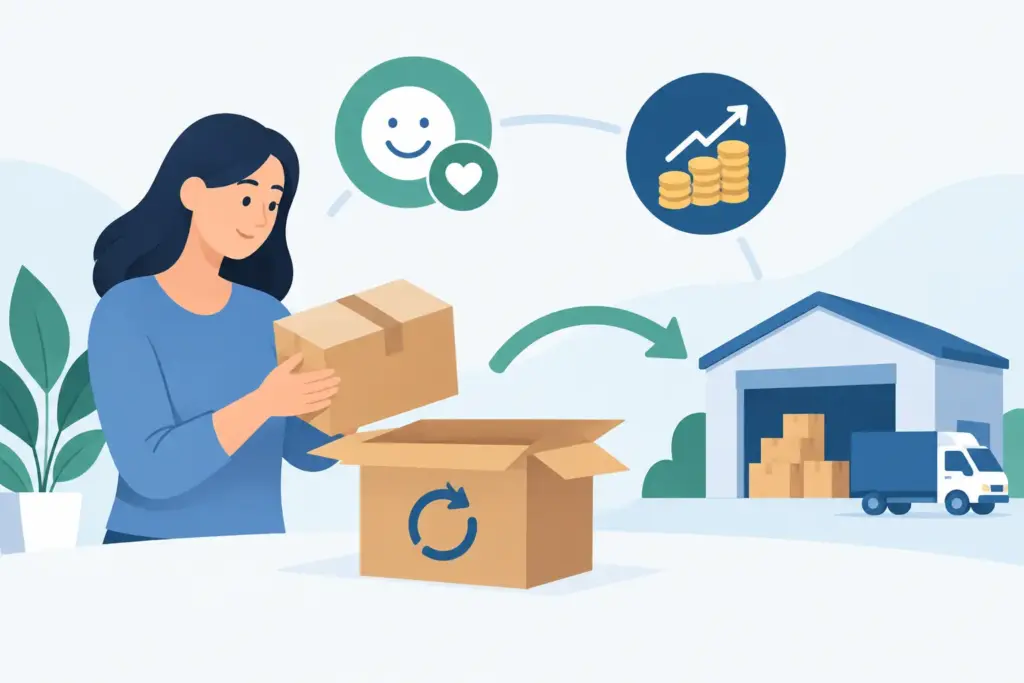
A customer has decided a purchase is not right for them. At that point, parcel returns become a defining moment for the brand – not a back-office exception. A difficult label process, limited drop-off options or poor tracking can turn one unwanted item into a customer who does not return. Get the experience right and the same return can build the confidence to buy again.
For retailers and brands handling meaningful volumes, returns are also a commercial and operational challenge. Every parcel touches customer service, warehouse capacity, carrier performance, inventory availability and margin. The aim is not simply to make returns easy. It is to create a controlled, visible process that gives customers choice without allowing avoidable cost and complexity to spread through the operation.
Why parcel returns deserve a delivery strategy
Returns are often treated as the final stage of fulfilment, configured after outbound delivery is live. That approach creates gaps quickly. A brand may offer fast delivery at checkout but provide only one inconvenient method for sending goods back. Its operations team may be able to track outbound parcels across carriers, yet rely on manual updates and customer emails to understand inbound return volumes.
Customers do not separate those experiences. They judge the purchase journey as a whole. A clear policy, a simple returns route and reliable visibility make buying feel lower risk, particularly for categories where fit, colour or personal preference lead to naturally higher return rates.
The commercial case is equally clear. Returns can delay the saleable recovery of stock, consume warehouse labour and create unnecessary carrier costs. Where the returned product is seasonal, limited in availability or high in value, every lost day matters. Better decisions at the point of return can reduce customer contacts, improve processing capacity and help stock get back into the right channel sooner.
That does not mean every business should offer unlimited free returns through every possible service. The right model depends on product value, customer expectations, margin, return reasons and the markets served. A premium fashion brand may prioritise convenience to support lifetime value. A bulky-product retailer may need more structured collection options. An international seller must also account for duties, documentation and the risk of goods sitting at a border.
Build a returns journey around choice and control
A strong returns experience gives the customer simple choices while giving the business consistent rules. Those two goals are not in conflict when the process is connected.
Customers should be able to access the correct return method without searching for instructions or contacting support. Depending on the product and destination, this may mean a printable label, a paperless QR code, a local drop-off point, a locker or a collection. Choice matters because a return that fits around a customer’s day is far more likely to arrive quickly and traceably.
Behind that customer-facing experience, the business needs logic. Which carrier service is available for this postcode? Which option is appropriate for the item’s size, value or destination? Does the order qualify for a prepaid return? Does a cross-border movement require specific paperwork? Without connected technology, these decisions are commonly handled through separate portals, spreadsheet rules and manual intervention.
A multi-carrier platform changes the shape of the problem. Rather than building different return processes around each carrier, operational teams can apply a consistent workflow and select services according to the requirements of each parcel. That creates flexibility when customer expectations change, service capacity is constrained or a particular carrier is better suited to a lane.
Start with return reasons, not carrier labels
The most useful returns data begins before the parcel leaves the customer. Capturing a clear return reason gives teams insight into product quality, product descriptions, sizing, packing and fulfilment accuracy. It also helps determine the best next action.
For example, an item reported as faulty may need a different route or inspection process from an unopened item returned because the customer ordered two sizes. A high-value product may justify a tracked collection, while a lower-value item may be best handled through a convenient drop-off network. Treating every return identically can be easy to administer, but it can also be expensive.
Return reasons should be simple enough for customers to complete honestly and structured enough for teams to analyse. The objective is not to put obstacles in the customer’s way. It is to spot patterns that improve the business upstream, whether that means adjusting a product page, changing packaging or addressing a recurring picking issue.
Visibility turns returns into actionable inventory
Once a parcel is in transit, the customer wants reassurance and the business needs certainty. Proactive status updates reduce the familiar questions: has my return been received, when will I get my refund, and what happens next? Clear communication matters most when a refund is dependent on the return arriving and passing inspection.
For operations teams, tracking data should support decisions rather than simply confirm movement. Visibility across carriers makes it easier to identify parcels that have not been handed in, routes with extended transit times and return volumes heading towards a particular site. With that information, warehouse teams can plan labour, customer service teams can communicate earlier, and logistics managers can challenge underperforming services with evidence.
The warehouse handover is just as important. A parcel marked as delivered is not necessarily a return that is ready to refund, restock or dispose of. Businesses need clear status definitions between carrier receipt, warehouse arrival, inspection and final resolution. If these milestones sit in disconnected systems, customers receive conflicting messages and teams spend time reconciling exceptions.
Integration is what makes this practical at scale. When order data, labels, carrier events and warehouse processes flow through connected systems, the return does not need to be chased across multiple portals. It becomes part of the wider fulfilment workflow, with a clearer audit trail from customer request to outcome.
International returns need deliberate design
Cross-border returns create additional friction because the outbound delivery is only half the customs journey. The return may require accurate commodity data, values, reason-for-export information and the right documentation to avoid delay or unexpected charges. The best outbound service is not always the best return solution, particularly where the customer is sending an item from a market with different carrier coverage or customs requirements.
A practical strategy starts by deciding where returned goods should go. For some businesses, sending everything back to the UK is appropriate. For others, a local or regional returns hub may reduce transit times, cost and environmental impact. The answer depends on product value, return frequency, resale potential and the operational capability to inspect and process stock in-market.
Consistency is vital. Customers should not be surprised by fees, duties or a process that looks materially different from the delivery experience. Equally, businesses should not absorb costs blindly. Clear policies, service rules and accurate data help strike the right balance between customer confidence and commercial control.
Measure the experience and the cost together
A returns programme can appear successful if it is easy for customers, while quietly eroding margin through premium services, slow stock recovery or avoidable handling. It can also appear efficient internally while damaging conversion because the customer journey is restrictive. The right measures show both sides.
Monitor the return rate by product, reason and market, but do not treat every increase as failure. A higher rate may reflect a more generous policy, stronger sales volume or a product category where customers deliberately order options. Look alongside it at cost per return, first-attempt hand-in success, time from customer request to carrier acceptance, transit time, warehouse processing time and time to refund or exchange.
Carrier performance should be assessed by lane and service, not just by an overall average. A national network may be excellent for domestic drop-offs but less suitable for a particular international route. Multi-carrier capability gives teams the freedom to act on those findings rather than remain locked into one option.
Make returns part of the customer promise
The best returns operation does not feel like a separate logistics process. It reflects the same promise made at checkout: clear choices, dependable delivery and useful communication. That requires technology that can connect carrier options, return instructions, labels, tracking events and operational workflows in one place.
For businesses managing growth across the UK and international markets, Clearview can help turn carrier complexity into a coordinated returns journey. The value is not simply having more services available. It is being able to make the right service available for each return, with visibility for customers and control for the teams responsible for margin and fulfilment.
A return may begin with a customer changing their mind, but it can still end with a stronger relationship. Give people a process that respects their time, give operations the data to act early, and give the business the flexibility to improve with every parcel that comes back.